
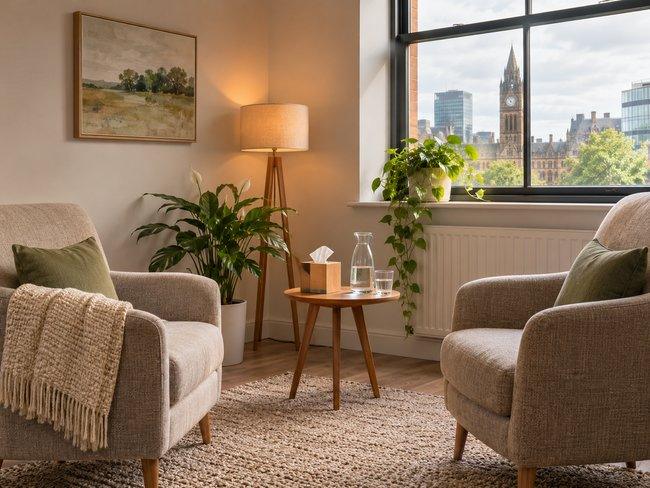
Psychotherapy in Greater Manchester is offered by a broad mix of independent practitioners and group practices, from consulting rooms in the city centre to therapy rooms in the surrounding towns and villages, and many also see clients by telephone or online. Practitioners train in different traditions, including humanistic, psychodynamic, person-centred, gestalt and integrative approaches, and many work with particular experiences such as trauma, grief and life transitions.
This selection looks at three psychotherapy practices in the Manchester area: Inner Sanctuary Counselling, LJE Therapy and Lisa Gibson Counselling & Psychotherapy.
Psychotherapists featured in this article:
Inner Sanctuary Counselling
Beth McManus is a trainee Human Givens therapist based in Greater Manchester, offering therapy sessions for adults through her practice, Inner Sanctuary Counselling. She has received Human Givens therapy herself during her own struggles, and she is training for the Human Givens Practitioner Diploma in this neuroscience-based therapy, which includes practical tools.
The Human Givens approach has been around for over 20 years and draws on findings from psychology and neurobiology about how people function and what they need to lead fulfilling lives. It rests on nine emotional needs: giving and receiving attention, security, community, intimacy, status, competency and achievement, control, privacy, and meaning and purpose. When people begin to struggle, the therapist looks at what is working in their life and the resources they have or can develop, using a range of techniques to work towards a better balance of those needs.
Sessions begin by getting to know each person and creating a space to tell their story and be heard without judgement. Together they explore what someone is struggling with or the positive changes they would like to make, what is getting in the way, and the inner resources drawn from life so far. Meaningful goals then set the direction, with the steps to reach them worked out backwards from today. A session may include learning skills to manage and regulate emotions, and everything is tailored to the individual and done at their pace.
She works with relationship challenges, self-harm, concentration challenges, emotional regulation, addiction of all kinds, obsession, phobias, depression, anxiety and stress, panic attacks, low self-esteem, sleep hygiene, positive behaviour changes and post-traumatic stress disorder.
She holds a BSc Hons degree, spent six years working in the NHS and seven years in sales and account management in a corporate environment. She is a competitive athlete and has been a member of her local running club for 25 years, has been a Cub Scout Leader for over 10 years, and leads and facilitates a local peer-to-peer support group for adult survivors of CSA, which brings people together through crafts, yoga, breathwork, cooking, map reading and hiking.
Sessions can be booked for 45 minutes, an hour or 90 minutes. In-person sessions take place in a room she hires on Underhill Road in Oldham, and a limited number of online sessions are available via Zoom, with a 15-minute discovery call as the first step.
Address: 2 Underhill Road, Oldham OL1 2JP
LJE Therapy
LJE Therapy is the practice of Laura Jane Seddon-Ellis, an integrative psychotherapist and clinical supervisor working in South Manchester. She is a registered member of the British Association for Counselling and Psychotherapy and holds a Postgraduate Diploma in Integrative Psychotherapy, awarded with Distinction, as well as a postgraduate certificate in clinical supervision from the Manchester Institute for Psychotherapy. She offers individual therapy for adults aged 18 and over, and supervision for trainee and qualified counsellors and psychotherapists, with face-to-face sessions in Chorlton and Stockport as well as online sessions by video.
Her training is rooted in humanistic, psychodynamic and person-centred therapy, and she draws on gestalt, transactional analysis, existential and transpersonal ideas, as well as attachment theory, object relations and self-psychology. She works as a trauma-informed practitioner, guided by the Power Threat Meaning Framework, which starts from what has happened to a person rather than from what is wrong with them. The work is collaborative and client-centred: she does not give advice or set homework unless it helps, and the aim is to strengthen each person’s autonomy, reflective skills and trust in their own decisions.
Laura Jane has more than a decade of experience with adults and children in the charity and non-profit sector. Her specialisms include working with members of the LGBTQIA+ community, people from marginalised backgrounds who have experienced developmental trauma, neurodivergent adults and young people, survivors of sexual abuse and people diagnosed with personality disorders. She offers queer-affirmative, anti-oppressive and neurodiverse-affirmative therapy. She was herself a client in long-term psychotherapy for several years, which gave her an added understanding of the depth and impact the work can have, and she also holds a BA in English and Cultural Studies from Manchester Metropolitan University.
People come to her when they feel stuck in old patterns, or are living with anxiety, low mood, grief and loss, including ambiguous grief such as that of a loved one with dementia or estrangement, life transitions, addiction, trauma and abuse, or want to build confidence, assertiveness and self-esteem. Sessions usually begin with a short check-in, and she offers weekly or fortnightly work, both fixed-term and open-ended, the latter being her specialism. Adjustments to lighting, temperature, scents, sounds or communication can be made, and walk and talk therapy outdoors is offered to regular clients. Support animals are welcome at the Stockport practice, subject to discussion.
Address: 5, 7 High Lane, Chorlton-cum-Hardy, Manchester M21 9DJ
Lisa Gibson Counselling & Psychotherapy
Lisa Gibson Counselling & Psychotherapy is a practice based in Chorlton, Manchester, run by Lisa Gibson, a qualified and experienced counsellor whose work is underpinned by person-centred theory, which treats each client as the expert in their own life. She works integratively, drawing on additional training in trauma and attachment, and her approach is gentle, accepting and compassionate, helping people reconnect with themselves and with the world. She offers a tailored approach, working to understand each person’s experience from their own perspective through empathy, acceptance and being fully present. The work is collaborative and at the client’s pace, and there is never any pressure to talk.
She works with anxiety, depression, anger, behavioural issues, self-harm, domestic abuse, trauma and post-traumatic stress, and women’s issues. With anxiety, including panic attacks and trouble sleeping, she explores triggers and ways of managing their impact, while with behavioural issues she uses cognitive behavioural techniques such as thought diaries, journalling, relaxation and breathing. For anger the work looks at its roots, triggers and impulse control, and with self-harm she focuses on grounding and stabilisation, including somatic exercises that bring awareness back to the body and the present moment. For depression she offers empathy and acceptance and explores self-care, self-acceptance and compassion, and for those affected by domestic abuse she helps clients gain clarity about abusive situations and rebuild confidence, supporting safety planning, trauma symptoms and work with anger, shame, guilt and trust issues.
Lisa has a special interest in working with trauma survivors, particularly those affected by adverse childhood experiences, rape and sexual violence. As a trauma-informed therapist she takes care not to trigger or re-traumatise her clients, and her approach draws on Judith Herman’s three-phase model of safety and stabilisation, remembrance and mourning, and recovery and reconnection. Grounding, sensory and somatic techniques, visualisation, breathing, journalling, inner child work and attachment theory may all be used, depending on need.
Having trained and volunteered for a number of years with local women’s organisations, she also has a particular interest in working with women, including those affected by child sexual abuse, sexual assault, sexism and oppression, and perinatal and postnatal depression, as well as motherhood, menopause and giving birth. She suggests six to twelve sessions, although she works open-ended, depending on what feels right for each person, and sessions last 50 minutes.